FAQ
The cabinets have no ignition source — but the light fitting and the fan must be marked.
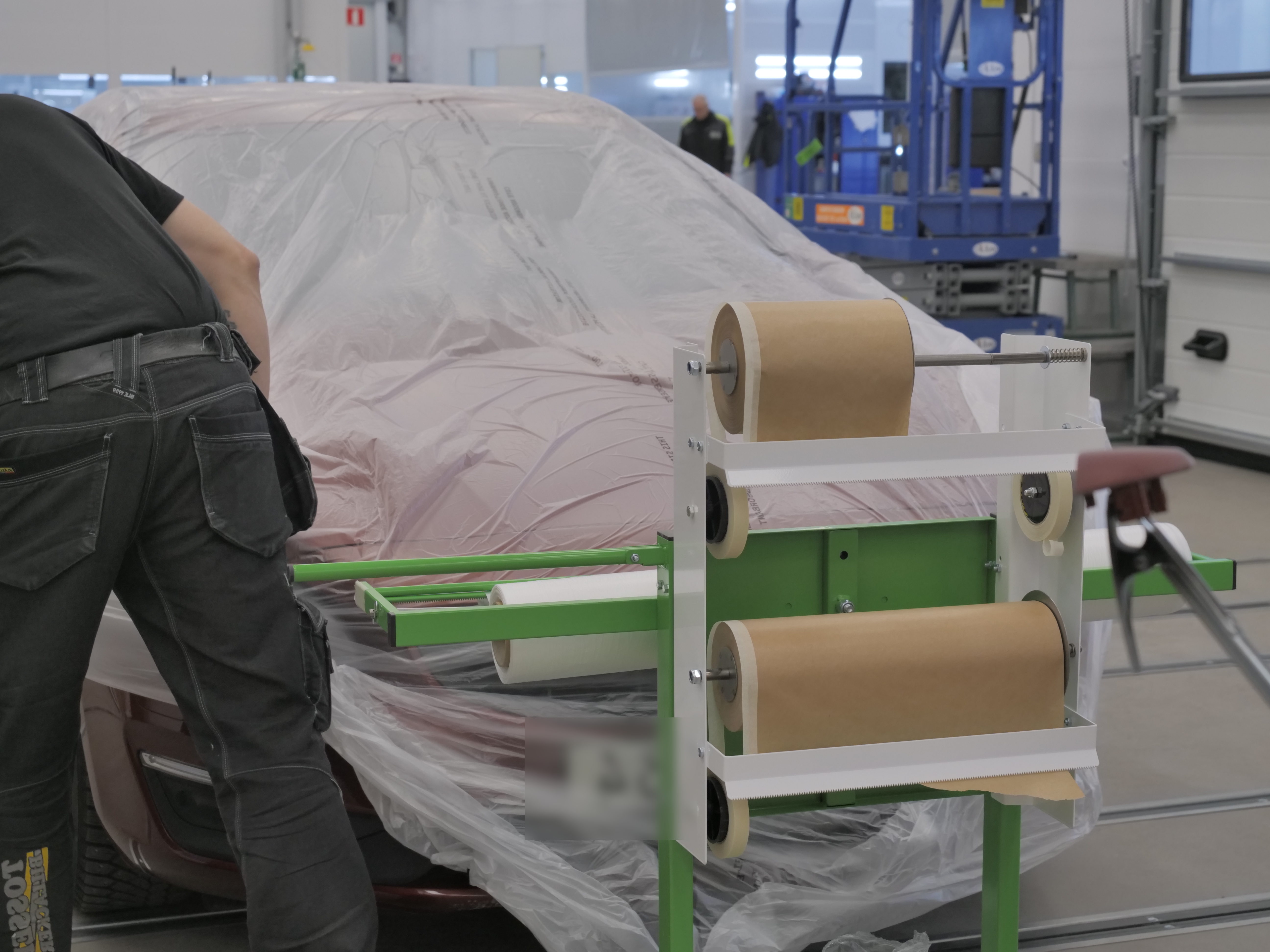
"Why aren't your cabinets Ex-rated?" The question comes up at regular intervals, often after an inspection or an insurance review. The answer tends to surprise: they should not be — and here is why.
What determines whether a piece of equipment must carry a CE mark and an Ex/ATEX rating is whether it has an inherent ignition source — something that can ignite an explosive atmosphere: a motor, a switch, a hot surface. A Green Line cabinet is a passive steel construction. No electrics, no moving parts, nothing that can produce a spark. There is simply nothing to rate.
We check regularly with accredited certification bodies, and the answer is the same every time.
This is where it matters. The equipment that is mounted in or on the cabinet — the light fitting and the exhaust-air fan — does have ignition sources, and must be Ex-marked if it sits in a classified area. So when you buy or inspect a mixing room: the cabinet needs no marking, but do check that of the light fitting and the fan.
Have you bought a light fitting or fan through us and want to check the marking? Get in touch with the date the cabinet was purchased and which dealer it came through, and we'll pull out the documentation.
How the zone classification of the premises itself is done we explain in the article Must the equipment be Ex-rated? →
This article is an overview, not legal advice. Always check the current regulations with the Swedish Work Environment Authority (Arbetsmiljöverket) and the Swedish Electrical Safety Authority (Elsäkerhetsverket). Last reviewed July 2026.
The question comes up at regular intervals, often after an inspection or an insurance review: "why aren't your cabinets Ex-rated?" The answer tends to surprise — they should not be, and as a rule they must not be either.
We check regularly with the certification bodies, and the view is unanimous: the Green Line cabinets are not Ex-marked, and should not be. Here are the four reasons.
The ATEX product requirements (AFS 2023:7, which replaced AFS 2016:4 on 1 January 2025) apply strictly to equipment that has a potential ignition source of its own. That means electrical components, motors, compressed-air diaphragm pumps or moving mechanical parts that can generate sparks or frictional heat.
A passive cabinet built from sheet steel has no such components. Because it has no ignition source of its own, it falls formally entirely outside the ATEX product requirements. To Ex-mark it as equipment would therefore be not merely unnecessary — it would be incorrect and misleading.
The only real risk a sheet-steel unit poses in an explosive environment is the build-up of static electricity. The solution to that is not to Ex-rate the unit, but equipotential bonding.
As long as the cabinet is built from conductive material and correctly connected to the mixing room's earthing system, no static charge can build up. That is the measure that actually removes the risk — a marking on the cabinet door does not.
This is where the most common confusion arises. The mixing room itself is already zone-classified — often zone 1 or zone 2 — under the rules for explosive atmospheres in the workplace (AFS 2023:10, chapter 9 — which replaced AFS 2003:3, among others). The volume inside and around the cabinet is part of that zone classification plan and is managed by the room's mechanical ventilation.
In that context the cabinet is merely passive fitting placed in the zone. You zone-classify the space. You do not Ex-rate the fittings.
If a customer, a safety representative or an inspector routinely demands an "Ex-rated cabinet" for passive storage, it has two consequences, and neither of them is good.
The documentation becomes invalid. The manufacturer is forced to issue an ATEX certificate for a sheet-steel construction. It has no support in the directive and does not hold up under close scrutiny — which is precisely the opposite of what the requirement was meant to achieve.
It gets more expensive without getting safer. The demands on documentation and maintenance are driven up entirely needlessly, without adding a single per cent of safety in the mixing room.
The cabinet is sold and installed as conductive fitting, included in the mixing room's existing zone classification plan, and connected to earth. The cabinet itself remains unrated.
There is a reason our cabinets are built around exhaust air and supply air rather than around explosion protection. A cabinet that is ventilated correctly carries the solvent vapours away before they can form an explosive atmosphere. The zone shrinks — and with it the requirements on everything else in the room.
It is cheaper, simpler and safer to ventilate the problem away than to certify your way around it. Ventilation requirements vary widely between products, from 100 m³/h for a Tiro to 4,100 m³/h for a Systemtvätt 195. Work it out before you decide, and we'll gladly help.
How the zone classification of the premises itself is done we explain in Which equipment must be Ex-rated?
