Workshop
Art. no. 9-080
Efficient extraction across the whole work surface
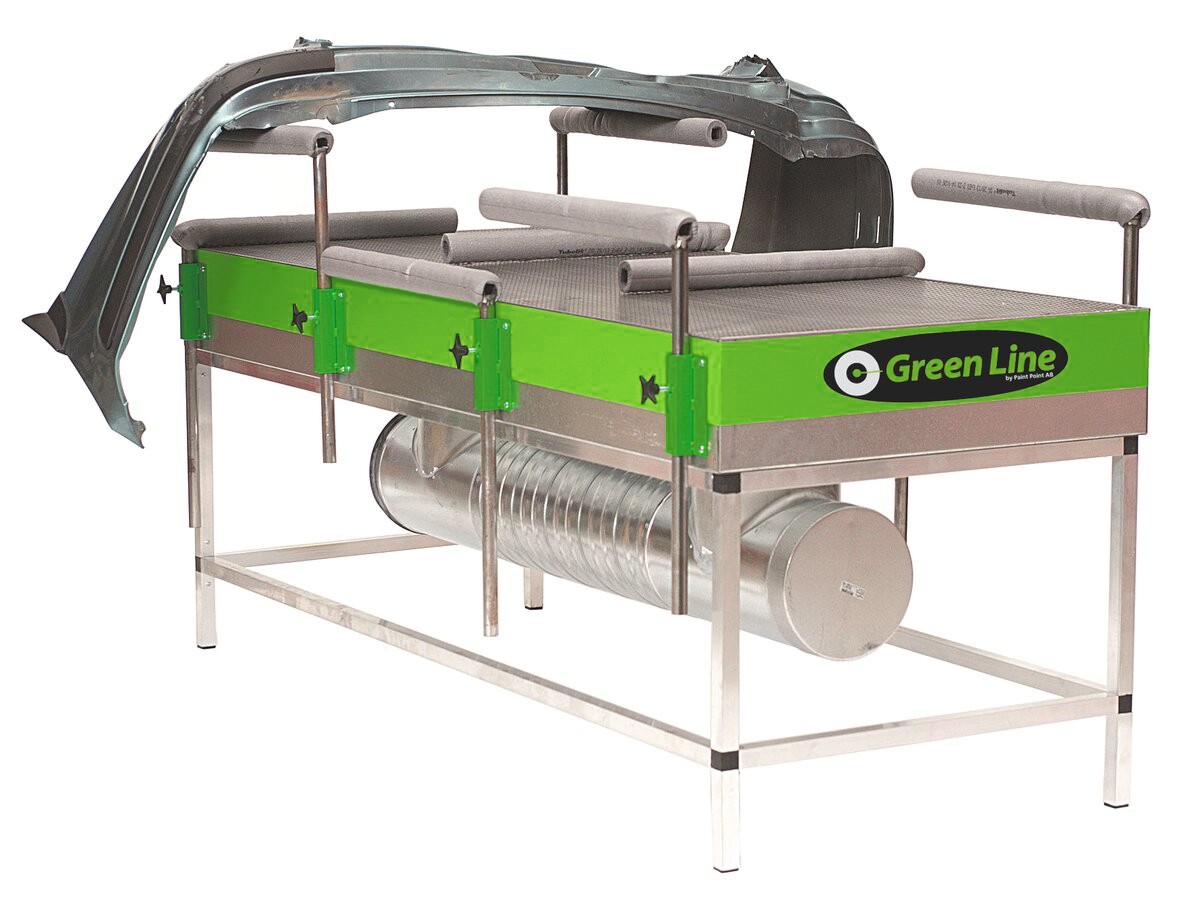
A robust sanding bench with a reinforced, perforated work surface that provides efficient extraction across the whole table – minimising dust and creating a cleaner, healthier working environment. Eight adjustable arms swivel, raise and lower individually to hold the workpiece in place. Ideal for plastic car parts and also suitable for materials containing isocyanates.
The perforated surface provides even extraction across the whole work surface – 1500 m³/h.
Swivel, raise and lower individually for optimal flexibility.
A comfortable height that reduces the risk of strain injuries.
Perfect for sanding all common plastic car parts. Add an extraction arm and the station meets the automotive-plastics group's requirements.
In depth
Green Line Slipbord is a sanding bench with extraction across the whole work surface. The entire tabletop is perforated, which gives an even negative pressure across the whole surface instead of spot extraction in a couple of places. The sanding dust is drawn away where it is created – not where the extraction happens to sit.
For the workshop the difference is tangible. Sanding dust that isn't captured in the bench ends up somewhere else: in the lungs, on surfaces about to be painted, in the ventilation. A bench that actually extracts across the whole surface is therefore both a working-environment issue and a quality issue for the paint result.
The sanding bench is particularly suited to sanding automotive plastics – bumpers, fender flares, spoilers and other parts that are otherwise hard to secure and reach from every angle. With eight adjustable arms that swivel, raise and lower individually, even a large and irregular part can be held in exactly the position the work requires.
The bench works equally well for fine sanding ahead of painting as for coarser work in the preparation phase.
The work surface is perforated sheet metal on a frame of aluminium profiles, measuring 2000 × 800 × 850 mm. The working height is set to give a comfortable posture that reduces the risk of strain injuries over a full working day – sanding is one of the tasks in the workshop that is hardest on the shoulders and back, and the bench height is one of the few things you can actually do something about.
The eight arms are individually adjustable, so the bench can be reconfigured between different types of part without tools.
The bench connects to the workshop's extraction via an exhaust-air connection of Ø250 mm and requires 1500 m³/h.
A sanding bench with extraction – or sanding table, as many call it – belongs in preparation, where parts are sanded before they move on to painting. Capturing the dust in the bench rather than letting it spread is crucial here: sanding dust that reaches a surface about to be painted turns into defects in the paint.
Over a full working day, sanding is also one of the workshop's most physically demanding jobs. The set working height and the eight individually adjustable arms let the part be held in the right position without unnecessary bending and stretching. Combined with the right dust extraction, the sanding bench becomes both a working-environment and a quality investment.
Frequently asked questions
To give an even negative pressure across the whole bench instead of spot extraction in a couple of places. The sanding dust is captured where it is created, wherever on the bench the part lies. Anything not captured otherwise ends up in the lungs or on surfaces about to be painted.
The eight arms swivel, raise and lower individually without tools. This means even large and irregular parts – bumpers, fender flares, spoilers – can be held in exactly the position the work requires.
The bench connects via Ø250 mm and requires 1500 m³/h.
The sanding bench is delivered on a pallet, standing on its edge. Tip it over into place, connect the exhaust air and start working.
The sanding bench with extraction across the whole work surface is built to support the working-environment and equipment requirements that MRF Bilplastteknik places on certified plastic-repair workshops. For spot extraction during certain steps, the bench is supplemented with an exhaust-air arm. See the MRF plastics brochure for the current requirements.
| Technical data | |||
|---|---|---|---|
| Art. no. | 9-080 | Designation | Green Line Slipbord |
| Size (W×D×H) | 2000×800×850 mm | Work surface | Perforated sheet metal |
| Adjustable arms | 8 | Frame | Aluminium profiles |
| Exhaust air requirement | 1500 m³/h | Exhaust air connection | 1 × Ø250 mm |